Download Presentations

This is a selection of presentations and posters recently presented by the partners of "HemiCoat".
Symbolbild

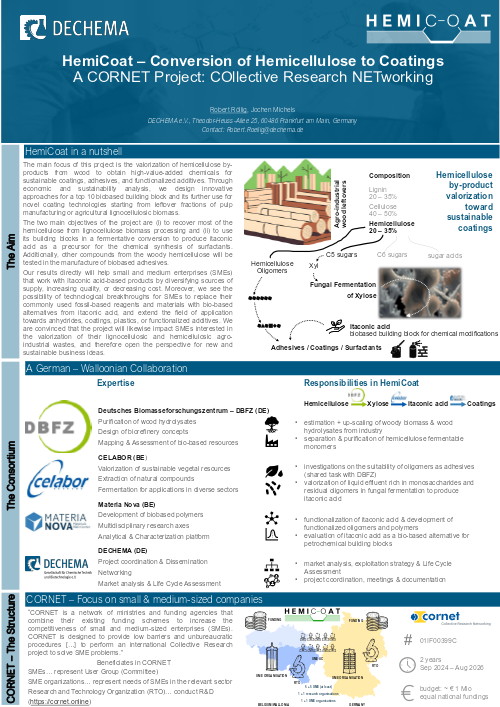
HemiCoat – Conversion of Hemicellulose to Coatings

Robert Röllig, DECHEMA e.V., Frankfurt, Germany

The Poster describes the aim and structure of the Hemicoat project. It was presented at the LignoBiotech Conference 14.-17.10.2024 in Toulouse, France
Download: HEMICOAT_Introduction_Poster_DECHEMA_2024-10.pdf

Symbolbild

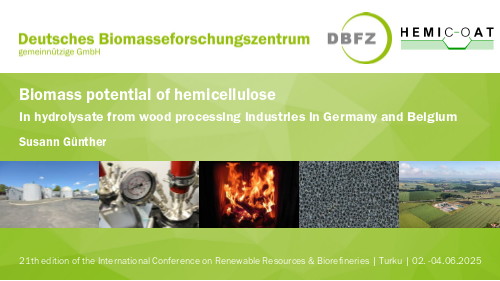
Biomass potential of hemicellulose in hydrolysate from wood processing industries in Germany and Belgium

Susann Günther, DBFZ, Leipzig, Germany

Potential analysis of hemicelluloses from hydrolysates based on interviews with companies, associations, experts in Belgium and Germany. It was presented at the International Conference on Renewable Resources & Biorefineries 02.-04.06.2025, Turku, Finland.
Download: HEMICOAT_Hemicellulose_potential_DBFZ_2025-06.pdf

Symbolbild

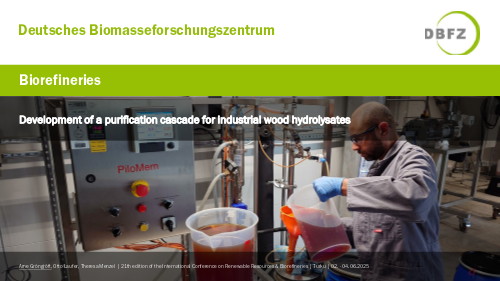
Development of a purification cascade for industrial wood hydrolysates

Arne Gröngröft, Otto Laufer, Theresa Menzel, DBFZ, Leipzig, Germany

Processing of wood pulping derived hemicellulose hydrolysates with the aim to separate and purify monomeric sugars as well as oligomers. It was presented at the International Conference on Renewable Resources & Biorefineries 02.-04.06.2025, Turku, Finland.
Download: HEMICOAT_Purification_cascade_DBFZ_2025-06.pdf

Download Deliverables

This is a selection of published Deliverables of the HemiCoat project.

Symbolbild

D1.1 – Estimation of feedstock potential (woody biomass and wood hydrolysate) from industry in Belgium and Germany

Susann Günther, DBFZ, Leipzig, Germany

The report assesses the biomass potential of hemicellulose hydrolysates arising from industrial processes in Belgium and Germany. The analysis focuses on wood and non-wood pulp production sites and lignocellulosic biorefineries, where hemicellulose-rich side streams are generated but are currently underutilised and largely incinerated, despite their limited energy value and significant potential for conversion into bio-based products.

Download: Deliverable D1.1.pdf

Symbolbild

D 1.2 – Up-scaling of feedstock potential from industry to EU level

Susann Günther, Andreas Schedl, DBFZ, Leipzig, Germany

The report extends the feedstock analysis of D1.1 (Belgium and Germany) to all EU-27 countries, establishing a harmonised, process-specific methodology for quantifying and spatially mapping hemicellulose potential in industrial lignocellulosic hydrolysates, as a large, currently underutilised side-stream of woody biomass processes, and predominantly burned for energy recovery.

Download: Deliverable D1.2.pdf

Symbolbild

D1.4 – Interim report on definitions, settings, and system for LCA (Life Cycle Assessment)

Robert Röllig, Jochen Michels, DECHEMA e.V., Frankfurt, Germany

The report reflects the relevant preparatory work for D1.5 LCA of hemicellulose oligomers and itaconic acid-based products in the HemiCoat project by providing the initial definitions, and settings, including the goal and scope definition and system descriptions, as well as all relevant technological parameters for the further tasks integrated in D1.5.

Download: Deliverable D1.4.pdf

Related Projects

Related EU projects on bio-based technologies

NEXT-STEP

Next-Gen of Sustainable Biobased Chemical Platforms and Polymers: Enhancing Sustainability in European Industry

NEXT-STEP aims to realize a sustainable, safe, and affordable way to produce groundbreaking bio-based chemicals at large scale to improve the sustainability and recyclability of Polyurethane products and open up new possibilities for bio-based Polylactic acid co-polymers.

Website: https://nextstep-cbe.com/